


I am strong Inspiring Stories of Resilience and Personal Strength

Strength does not always look loud. Sometimes it looks like getting out of bed after a hard night. Sometimes it looks like asking for help, trying again, or choosing to hope when the evidence feels thin.
Every person carries a story of survival. Some stories are dramatic and visible. Others are quiet, private, and known only to the person who lived them. A lost job. A painful breakup. A health scare. A childhood wound. A season of anxiety. A dream that failed. A responsibility that felt too heavy.
Yet here you are.
That matters.
Personal strength is not the absence of struggle. It is the choice to keep showing up, in whatever way you can, even when life changes shape. Resilience grows through that process. It is built in small moments, through courage, patience, rest, support, and honest self-belief.

Strength often begins in the hardest chapters
Most people can point to at least one season that changed them.
It may have been a time when plans fell apart. A time when grief made ordinary tasks feel impossible. A time when confidence disappeared. A time when the future felt unclear.
During hard seasons, strength rarely feels like strength. It can feel like exhaustion. It can feel like uncertainty. It can look like crying in the car, calling a friend, taking a walk just to breathe, or doing the next necessary thing with no applause.
That is still strength.
Resilience is often described as bouncing back, but that phrase can make healing sound too simple. Many people do not bounce back to who they were before. They move forward as someone changed. Someone wiser. Someone with new boundaries, deeper compassion, and a clearer sense of what matters.
The phrase “I am strong” is powerful because it brings attention back to what is already present. It does not deny pain. It does not pretend everything is easy. It simply says, “I have something within me that can meet this moment.”
That belief can become a lifeline.
Stories of resilience remind us what is possible
Inspiring stories do not erase anyone’s pain. They remind us that human beings can endure, adapt, and rebuild. The details differ, but the pattern is familiar: a challenge arrives, life becomes difficult, and a person finds enough courage to take the next step.
Malala Yousafzai showed courage in the face of fear
Malala Yousafzai became known around the world for speaking up for girls’ education. As a young student in Pakistan, she faced threats for believing that girls deserved to learn. After surviving a violent attack, she continued to advocate for education and became a global voice for courage and justice.
Her story is extraordinary, but the lesson reaches into ordinary life. Courage does not mean fear disappears. Courage means fear does not get the final word.
Many people face moments when speaking up feels risky. It may be a conversation with a family member, a decision to leave an unhealthy situation, or the choice to defend someone who is being treated unfairly. Malala’s story shows that one voice, steady and clear, can carry great strength.
Viktor Frankl found meaning in suffering
Viktor Frankl, a psychiatrist and Holocaust survivor, wrote about the human search for meaning after living through unimaginable suffering. His work has helped many people think about inner freedom, purpose, and the strength to choose one’s response even in terrible circumstances.
His story must be treated with care, because no simple lesson can capture the horror he and millions of others endured. Still, one idea from his life continues to move people: meaning can help a person survive even when life is painful.
For some, meaning comes through love. For others, service, faith, creativity, family, or the hope of helping someone else. In difficult times, meaning can become a small light that says, “Keep going. This pain is not the whole story.”
Wilma Rudolph turned hardship into determination
Wilma Rudolph faced serious illness as a child and had to work hard to regain her strength. She went on to become an Olympic champion in track and field.
Her life reminds us that the body and spirit can surprise us. Progress may come slowly. Recovery may require support, practice, and patience. Yet small gains add up. A person who feels limited today may one day look back and recognize how far they traveled.
Wilma’s story also speaks to anyone who has felt underestimated. Other people’s doubts are not a life sentence. A hard beginning does not decide the whole future.
Ordinary people carry quiet courage every day
Not every inspiring story becomes famous. Some of the strongest people never stand on a stage.
Think of the parent who works long hours, then still reads a bedtime story. The student who fails an exam, studies again, and passes the next one. The person in recovery who chooses one more sober day. The caregiver who keeps loving through exhaustion. The adult who returns to school after years away. The friend who admits, “I am not okay,” and lets someone help.
These are not small things.
Quiet resilience deserves respect. Much of life is built by people who keep going without being seen. Their strength is real, even when it is not celebrated.
Your own life already contains proof
When confidence is low, the mind can forget its own history. It can focus on what went wrong, what still hurts, or what feels unfinished. That is why reflection matters. It helps bring evidence back into view.
There have been times when life asked more of you than you expected. You may not have handled everything perfectly. No one does. But you made it through something.
Pause and ask yourself:
What is one hard season I have survived?
What did I do then that helped me keep going?
Who supported me, and how did I allow support in?
What did that experience teach me about myself?
What would I say to someone else who had lived through the same thing?
These questions are not meant to force gratitude for pain. Pain does not need to be made pretty to be meaningful. The goal is to notice your own endurance.
You may discover that you were braver than you believed. You may see that you made wise choices under pressure. You may remember that you asked for help, protected your peace, learned a skill, ended a harmful pattern, or simply held on.
That is evidence.
You do not need to feel strong every moment to be strong. Sometimes strength is the decision to begin again.
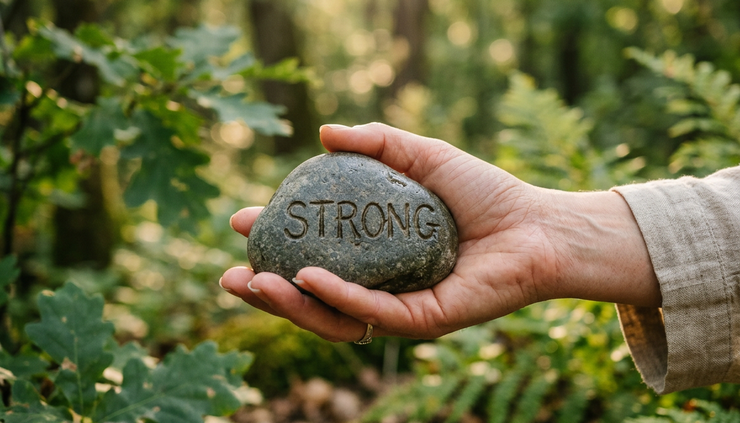
Affirmations can help train self-belief
Affirmations are short statements that direct the mind toward truth, courage, and possibility. They are not magic. They do not replace support, therapy, rest, or practical action. But they can help interrupt harsh self-talk.
The way you speak to yourself matters. A steady inner voice can make hard moments feel less lonely.
The affirmation “I am strong” works because it is simple. It can be repeated in the morning, written in a journal, whispered before a difficult conversation, or used during a stressful moment.
Try these practical affirmations:
I am strong.
I have survived hard things before.
I can take one step at a time.
I do not have to do everything perfectly.
I am allowed to ask for help.
My feelings are real, and they will pass.
I can keep going gently.
I trust myself to learn and grow.
I am more than this difficult moment.
I deserve patience, care, and respect.
For affirmations to feel more natural, connect them to action. Instead of repeating words without thought, pair them with a small behavior.
For example:
Say “I am strong”
Say “I can take one step”
Say “I am allowed to ask for help”
Say “I deserve care”
Take three slow breaths
Choose one small task
Text someone safe
Drink water, rest, or step outside
This makes the affirmation feel grounded. The words become a bridge to action.
Resilience grows through small daily choices
People often imagine resilience as a dramatic act of bravery. Sometimes it is. More often, it grows through ordinary habits that support the mind, body, and heart.
Keep the next step small
When life feels overwhelming, the whole path can seem impossible. Shrink the focus.
Make the next step clear and manageable. Wash one dish. Send one email. Take one shower. Make one call. Step outside for five minutes.
Small steps count because they create movement. Movement builds confidence.
Let support be part of strength
Many people think being strong means handling everything alone. That belief can make pain heavier.
Real strength often includes connection. It takes courage to say:
“Can you listen?”
“I need help.”
“I am struggling.”
“Can you sit with me for a while?”
Support may come from friends, family, a support group, a counselor, a faith community, or a trusted mentor. Accepting help does not make strength smaller. It gives strength a place to rest.
Protect your energy
Resilience is harder when every part of life drains you. Some challenges cannot be avoided, but some boundaries can be set.
That may mean limiting time with people who constantly criticize. It may mean taking breaks from stressful conversations. It may mean saying no without a long explanation. It may mean choosing sleep over one more task.
Boundaries are not selfish. They help preserve the energy needed to heal and grow.
Remember that rest is productive
Rest is often treated like a reward for finishing everything. But human beings need rest to function well.
A tired mind can make problems feel larger. A rested mind often sees options more clearly. Sleep, quiet, prayer, meditation, reading, time outdoors, or simply doing nothing for a few minutes can support resilience.
Rest does not mean giving up. It means refilling what life has emptied.
How to recognize the strength you already have
Strength can be hard to see from the inside. People often minimize their own courage because they know how scared or uncertain they felt at the time.
But being afraid does not cancel bravery. Doubt does not cancel progress. Tears do not cancel endurance.
To recognize your strength, look for signs like these:
You kept going when things were uncertain.
You learned from something painful.
You changed a pattern that was hurting you.
You told the truth about what you needed.
You cared for someone else while carrying your own pain.
You started again after disappointment.
You chose hope, even briefly.
If even one of those is true, strength has already been present in your life.
A helpful exercise is to write a short letter to yourself from the perspective of a kind friend. Describe what you have survived. Name what took courage. Mention the effort no one saw. End with the words, “I see your strength.”
Reading that letter later can become a reminder when doubt returns.
Let your story become a source of courage
No one gets through life untouched by difficulty. Some wounds heal quickly. Others take time. Some leave scars. Yet scars can become reminders of survival, not shame.
Your story does not need to look inspiring to anyone else in order to matter. It does not need a perfect ending. It does not need clear lessons tied up neatly. If you are still healing, still learning, or still finding your footing, your strength still counts.
Say it slowly if you need to.
I am strong.
Say it when you believe it. Say it when you do not. Say it as a promise, a reminder, or a beginning.
Then take one small step that honors those words. Rest. Reach out. Try again. Set a boundary. Forgive yourself. Make the appointment. Take the walk. Drink the water. Start the page. Let the day be imperfect and keep moving anyway.
Personal strength is not reserved for a few remarkable people. It lives in ordinary hearts that keep choosing life, love, healing, and hope.
You have made it through hard things before.
There is strength in you now.


Comments